
A Comprehensive Look at Risk Management in Ammonia and Fertilizer Facilities: What NFPA 660 Means for Your Operation
For over three decades, AcuTech has worked with ammonia, nitric acid, ammonium nitrate, and urea producers to identify and manage some of the most consequential process safety risks in the industry. That depth of experience is why the AcuTech team is heading to the 70th AIChE Safety in Ammonia Plants Symposium this year. Ahead of the event, we sat down with Doug Siegert, Principal Consultant and a Certified Process Safety Professional (CCPSC). We asked his current thoughts on risk management in Ammonia production and processing. His answer points to a hazard that’s gaining new attention across the fertilizer and ammonia sector: combustible dust. We’ve summarized the conversation below to highlight the necessity of identifying and managing all risks associated with any given process.
An Emerging Focus Area for Ammonia and Fertilizer Operators
Historically, ammonia fertilizer facilities have focused heavily on the toxic and process safety risks associated with anhydrous ammonia, pressure systems, and hazardous chemical inventories. Those hazards remain critical. But many organizations are now taking a closer look at combustible dust risks that may be associated with fertilizer manufacturing, blending, conveying, storage, and packaging operations — or even tangential operations elsewhere in the same organization.
That increased attention has been reinforced by NFPA 660, Standard for Combustible Dusts and Particulate Solids, which became effective on December 6, 2024. The relatively new standard consolidates a number of previously issued NFPA standards into a single document, designed to make navigating the risk management landscape easier for facility operators.
Which Materials Are We Talking About?
|
The fertilizer industry often handles materials that can generate combustible particulate solids or dusts requiring evaluation.
|
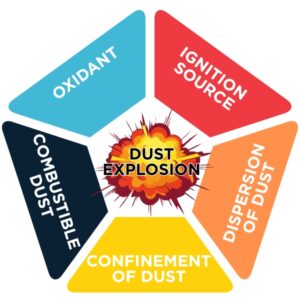
All five elements of the explosion pentagon (dispersion, confinement, fuel, oxygen, and ignition) must be present for a dust explosion to occur. |
Lessons From Past Incidents
The industry’s renewed focus is supported by lessons learned from several catastrophic dust explosions. The 2008 Imperial Sugar refinery explosion, which resulted in 14 fatalities and dozens of injuries, remains one of the most widely cited reminders of the devastating consequences of uncontrolled combustible dust accumulations. More recent industrial incidents across a variety of sectors have reinforced that combustible dust hazards continue to be underestimated, despite decades of regulatory and industry guidance.
One of the guiding Process Safety Culture principles discussed in the CCPS publication Essential Practices for Creating, Strengthening & Sustaining Process Safety Culture is to “maintain a sense of vulnerability”. One of the reasons this principle is included is to address the oft-used “it’s never happened here before!” rationale. While dust explosions may not rise to the same risk-level as toxic releases, clear identification and management of dust hazards is an important aspect of a facility’s overall process risk management program.
So what should fertilizer industry operators be doing? Hazard Identification and the Dust Hazard Analysis
The foundation of any combustible dust management program begins with hazard identification, primarily through material characterization. Facilities should understand the explosibility and combustibility characteristics of their materials through laboratory testing and review of available data.
Once hazards are understood — and if there is a credible hazard — organizations should complete a Dust Hazard Analysis (DHA) to systematically identify ignition sources, dust accumulation points, explosion propagation risks, and the effectiveness of existing safeguards. NFPA 660 continues to identify the DHA as a cornerstone of an effective combustible dust risk management strategy.
Building Combustible Dust Prevention Into Your Management System
Just as importantly, organizations should integrate combustible dust prevention into their broader management systems. Key program elements include:
- Housekeeping programs that prevent hazardous dust accumulations
- Operating procedures addressing normal, startup, shutdown, and upset conditions
- Hot work permitting and controls designed specifically for combustible dust environments
- Appropriate personal protective equipment (PPE)
- Inspection, testing, and preventive maintenance programs for process equipment and dust collection systems
- Employee and contractor training
- Contractor management practices
- Management of Change (MOC) reviews
- Pre-Startup Safety Reviews (PSSR) or operational readiness reviews
- Periodic management system audits and reviews
- Robust employee participation processes that encourage hazard identification and reporting
- Special Considerations for Agricultural and Fertilizer Facilities
For agricultural and fertilizer operations, special attention should also be given to the industry-specific requirements incorporated within NFPA 660 for agricultural and food-processing-related facilities. These provisions address hazards associated with bulk material handling systems, conveying equipment, storage operations, and other processes common throughout the fertilizer supply chain.
The Bottom Line
Combustible dust may not have historically received the same level of attention as ammonia releases or pressure vessel failures, but it is increasingly becoming a significant area of focus for regulators, insurers, and facility operators alike. By proactively characterizing materials, performing DHAs, and strengthening their management systems, organizations reduce risk, improve compliance, and prevent the next catastrophic dust incident.

See Doug at the 70th Annual Safety in Ammonia Plants and Related Facilities Symposium
This conversation with Doug is a preview of the kind of insight AcuTech brings to the field — and we’ll be bringing more of it to Montreal this year. AcuTech is attending the 70th Annual Safety in Ammonia Plants and Related Facilities Symposium, hosted by AIChE, August 30 – September 3, 2026 at Le Centre Sheraton Montreal. This year’s theme, marking a century of ammonia synthesis technology, focuses on the industry’s continual progress in ammonia plant safety.
If your organization is evaluating combustible dust risk, preparing for NFPA 660 compliance, or looking to strengthen your broader PSM or ammonia refrigeration safety program, we’d like to talk. Stop by the AcuTech booth in Montreal, or reach out to Doug Siegert, Principal Consultant, ahead of the conference to schedule time to connect.
About Doug Siegert
 |
Doug’s career spans site-level PSM leadership in ammonia production operations, platform-wide EHS and PSM ownership across a national manufacturing footprint, and hands-on Process Hazard Analysis facilitation for anhydrous ammonia, nitric acid, sulfuric acid, NG and LNG plants, among others. He holds credentials as a Certified Safety Professional (CSP), Certified Hazardous Materials Manager (CHMM), Certified Process Safety Professional (CCPSC) and Lean Six Sigma Black Belt. Doug also holds IIAR 6 and IIAR 9 certifications specific to ammonia refrigeration systems. |